Chapter I
How the
Darknalls came to Sussex
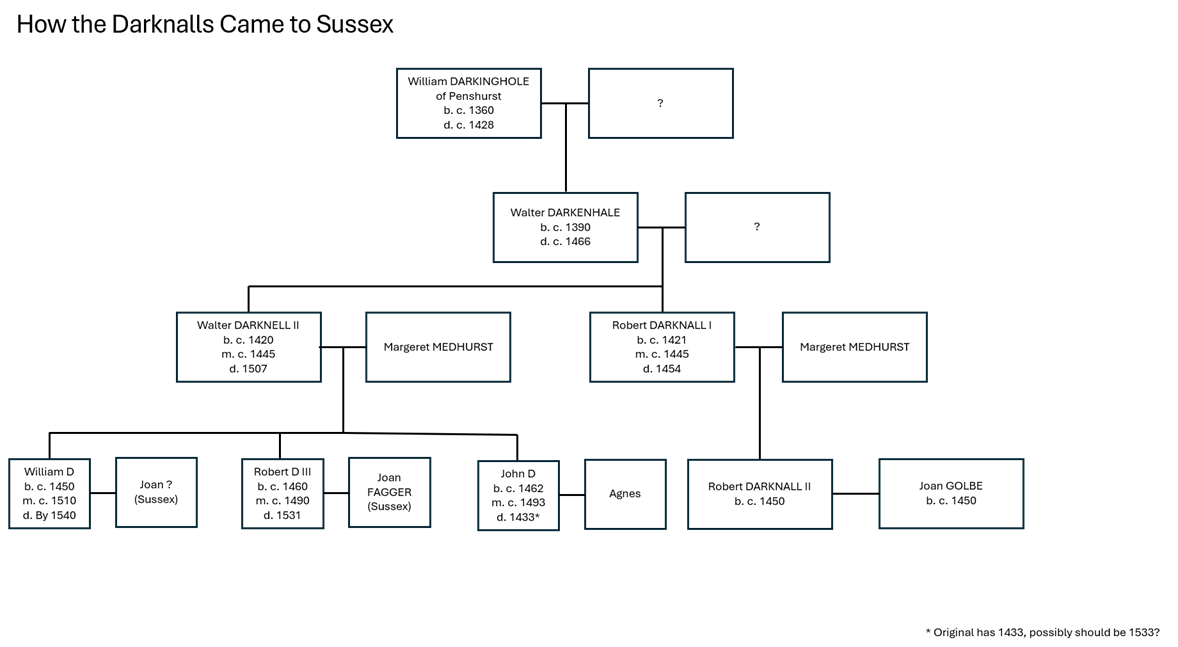
During the reign of Henry IV, between 1380
and 1395, Walter Darknall was born at Penshurst, in Kent, the younger son of
William Darknall. He married early and had two sons,
(a) Walter II, b. c.
1420
(b) Robert I, b. c.
1422
His land transactions covered
Penshurst, Chiddingstone, Cowden, Otford and elsewhere. His most important
property was Salmons in Penshurst.
SALMONS
Roger Salmon came to Penshurst about 1327
and built the original farmhouse. From a modest beginning, the new farm
expanded to some 110 acres by 1507. Walterr Darknall, who lived nearby, was a
tenant of Salmons in 1420.
The owner at the time was Roger’s grandson William Salmon.
It must be remembered that by 1450 the
Darknall family were witnesses to the earliest Salmons deed in 1403 as adjacent
landowners. Quite apart from the farm at Dorkinghole in Leigh a short distance
away, John Darknall in 1392 owned Lorekins and Vexore Farms and much other
small property nearby. William Darknall in 1332 married the daughter of William
Hatheridge and so became heir to that property which was next to but not then
part of Salmons. Just to the north, in 1404, John Darknall was the owner of Gilderidge
Farm. In fact, by 1420, William mself surrounded on all sides by farms owned or
occupied by members of the Darknall family. It is possible that this influenced
him in 1434 to sell Salmons to John Howe who promptly passed it to Walter
Darknall I and Henry Slighter.
HATHERIDGES
Somerden Hundred Rolls show that William de
Derkynghole heir of William de Hadderige paid 12d. tax for this land in
1332. His great grandson, Walter Darknell, held part of Hatheridges with
John Knight before he acquired an interest in Salmons in 1420. Thirty
years later, in 1451, Walter obtained a further share which consisted of a
small farm tenement of some 72 acres adjoining (in fact part of) the present
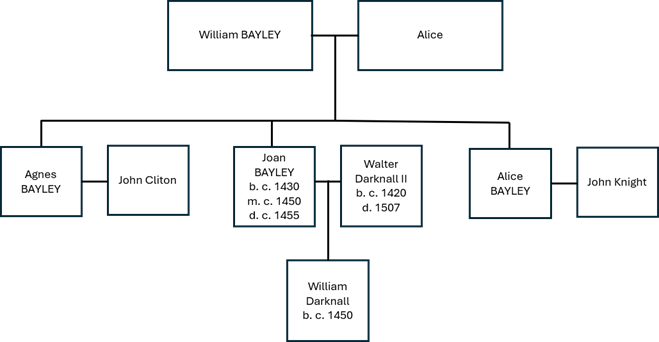
Salmons Farm. Another person interested in Hatheridges was William Bayley; he
owned part of it. His daughter Joan married Walter Darknall’s son Walter II c.
1450 and obtained the land from her father at the time. Joan Darknall died c.
1454 and left the property to her infant son William.
At this stage it is necessary to consider
William Bayley. His daughter’s marriage was one of the greatest importance to
the Darknall family. He was a member of a well know Sussex family, wealthy and armigerous. The Darknall
family would have been described as being well-to-do and were also armigerous.
The arms of Darknall and Bayley may be seen today in Penshurst Church. No doubt
it was regarded as a good match. Many details of the Bayley family will be
found in Sussex Archaeological Collections.
Walter must have married Joan c. 1450 and
William must have been born c. 1450/51 because Walter certainly married his
second wife Agnes Slighter (of whom more anon) 1455-1460. William Bayley had
two other daughters; Agnes who married John Cliton and Alice who married John
Knight. The Clitons and the Knights were also well-known Penshurst families
with large interests in neighbouring Sussex.
The following brief pedigree will
suffice.
About 1430-1440, William Bayley bought from
Walter Waleys (Wallis, Welsh) some 80 acres of land near Mayfield in Sussex. He saw all his
daughters married but in 1483 the position was as follows
(a) William Bayley
was dead
(b) Joan
Darknall was dead
(c) Alice Knight was
dead
William Bayley left his property equally
divided between his three daughters;
failing direct heirs to any daughter, the inheritance was to pass to the heirs
of the others. He died c. 1455; thus, in 1483, the heirs were
(i)
Agnes Cliton (daughter)
(ii)
Wwilliam Darknall (grandson)
(iii)
John Knight (grandson)
The following abstract from the
Chancery Proceedings tells us a little about Walsh’s which is further described
in Sussex Records. The Bayley family appear in the Close Rolls 1409.
Early Chancery Proceedings of Richard III, 1483-85
“To John, Bishop of Lincoln and Chancellor.
Meekly beseacheth yr. good Lordship, John Cleton and Agnes his wife, daughter
and heir of Wm Bailey, Wm Darkingwold, son and heir of Johane another daughter
and heir of Wm Baylly, and John Knight, son and heir of Alice, third daughter
of the said Wm Baylly. That whereas the said William Baylly was seised of a
toft and fourscore acres of land called ROMDENS and of a toft and eighty acres of
land called WALSH’S in RETHERFIELD in his demesne of fee, in very trust thereof
enfeoffed one William Turke, Thomas atte Well and others deceased to the use of
the said William Baylly and his heirs by virtue whereof the said William Turke
and his co-feoffee were seised of the same. And after that the said William
Baylly deceased. And howbeit the said William Turke since the death of the said
William although oftentimes requested by your beseachers to make estate of the
said lands and tenements to the said Agnes and William Darkingwold and John
Knight as heirs of the said William Baylly according to right hat at all times
refused. May it please your good lordship to grant a writ of subpena directed
to said William Turke commanding him to answer to the same.”
The little difficulty about Walsh’s in
Mayfield was caused by Walter Darknall’s second marriage about which we shall
read in the next chapter. Briefly, William Bayley, before he died, gave
instructions that his property should pass to his descendants and not
to the descendants of the Sleighters. Equally, Henry Sleighter wanted his by no
means inconsiderable lands to go to his grandchildren and not to William
Darknall who was no blood relation whatever.
William Bayley’s will was circumvented in
some legal way. A hundred years later some of the Bayley land was owned by
Henry Sleighter’s great grandchildren while some of the Sleighter property was
possessed by William Bayley’s great grandchildren. And the interesting part of
this was that both families lived within a few miles of one another, witnessed
each other’s wills, called each other cousin and lived not in Kent but in
Sussex. Twelve generations later, these adventures provided many interesting
problems for the family genealogist.
It is of interest to note also that in 1450,
amongst many others, representatives of three Kentish families were pardoned
for taking part in Jack Cade’s rebellion. They were
William
Bayley of Mayfield
William
Waleys
Richard
Darkenhole of Penshurst
Chapter II
The Story of
Walter Darknall of Penshurst
This refers to Walter II; his life story
will be found in “DARKNALL of SEVENOAKS’; it is full of interest. The following
brief summary may suffice to show how he influenced his family’s activities in
Sussex.
In the previous chapter, we have seen how
his father, Walter I, acquired Salmons in Penshurst, part of which he left to
his elder son Walter on his death in 1466. Now we must study Walter II closely.
There was a great difference
between the social standing of the Bayleys on the one hand and the Slighters on
the other. The Bayleys were an important Sussex and Kentish family and bore
arms. Henry Slighter, the father of Agnes, was a rich man but his father
was a blacksmith. At the time of the Bayley marriages the Darknalls also bore
arms, as they do today. But all the documents we have indicate that there was
little love lost between Bayley and Sleighter.
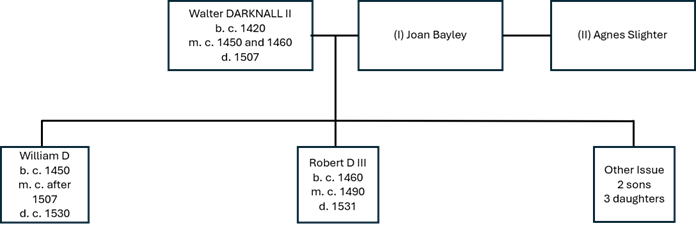
Some years before he died, Walter Darknall
II left clear instructions for his arms to be set up in Penshurst Church and
the brass shows himself, two wives, four sons and three daughters. In no deed
is there mention of the fourth son by name nor is he referred to in his
father’s will. The assumption, therefore, is that he died as a child.
Part of the undermentioned properties came
to the Darknall family as the result of Walter’s two marriages
Joan Bayley brought with her
(a) Walsh’s in
Mayfield
(b) Chaffords
on the Kent Sussex border
(c) Hatheridges in
Penshurst
Agnes Slighter (or Sleighter) was
responsible for
(d) Part of Salmons
(e) Minor
property in Penshurst
(f)
Jessops
(g) Dodd’s
Land
(h) Much money
The fact that Walter II was
distrained for Hatheridges in 1453 indicates that this property, part of which
had belonged to Willam Bayley had passed to Walter on his marriage to Joan. Hence,
Walter was married c. 1450. Just twenty years later, their son William was
signing deeds. Hence, William was born c. 1451.
By 1461, Walter was in possession
of some of the Slighter land so he must have married Agnes c. 1460. The elder
of their two sons, Robert III, was married before 1492 and Robert was
very active himself at the time in buying land on his own account. Robert must
have been born 1460-65.
A glance at the pedigree will
show that this Robert III had an elder cousin Robert II, some ten years older
than he. (For the benefit of later genealogists, a law should have been passed in
those Plantagenet days prohibiting cousins from bearing the same Christian
names.)
Reference must now be made to a
very important deed dated 1492.
In this, it is shown that Salmons, which included land known as Hatheridges,
was settled on Walter Darknall II for life with remainder to his son Robert and
to Robert’s wife Joan (Fagger). This required the agreement of Walter’s nephew,
Robert II, who only now appears in this story. It must be remembered that
Walter’s brother, Robert I, died as a young married man in 1453/4.
After a full lfe, Wlter Darknall
II died 21 March 1507 and is buried in Penshurst Church. The brass over his
grave is inscribed as follows:
“Pray for the
soul of Watir Darnowll
And Johane and
Agnes his wyfys
The which Watiir decessyd
the
XXI day of Marche
in the yere of Lord God 1507
On whose soulys Jhu have
mercy
Amen”
The Salmons deeds are in Sevenoaks Public
Library, with a copy of Walter’s will. Walter was a wealthy man but leaves all
his property to his second son Robert and to the youngest son John. Robert it
should be noted received Pilbeams, Salmons and Hatheridges. John was equally
well served but William, the eldest son, received nothing from his father.
He obtained “all lands and tenements called WALEYS lying in MAGHFELDE, Sussex”.
This was odd because it was not Walter’s to leave in the first place. It was
the inheritance of his late wife’s (Joan Bayley) and should have been passed to
William on his becoming of age, c. 1471. Why William did not fight for his
rights is not known.
Chapter III
The Story of
William Darknall of Chafford
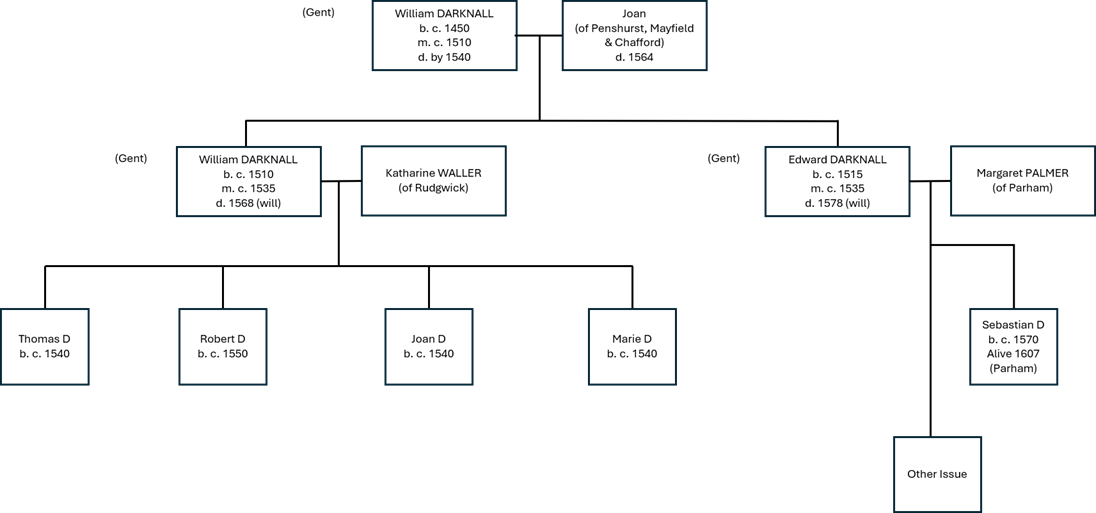
As we know, William was the eldest son of
Walter Darknall II and his first wife Jooan Bailey or Bayley; from his mother, William
acquired
(a) Walsh’s in
Mayfield (80 acrs)
(b) Part
of Hatheridges in Penshurst
(c) Chaffords,
on the Kent-Sussex border
(d) Possibly other
property.
But we know very little about
William. He must have [been] a bachelor (or a childless widower) in 1505 when
his father made his will and in 1507 when his father died. Soon after1507
Wiliam Darknall, Gent., left Penshurst and became “of Chafford”, quite close to
Mayfield. In 1511/12, he appears as bedel of the Weald, a minor office once
held by his father and uncle.
Hs story might have ended here
had it not been for some detailed research in Sussex and the discovery of an
old and very important will; added to this, William’s half-brother Robert married
into another important Sussex family – Fagger. From a genealogical point of
view, the pedigree was becoming very involved; it took over 40 years to sort it
out.
Did William marry? There can be
little doubt (but no definite proof) that he did. It is suggested that he
married after 1507 a lady very much younger than himself. Her name was Joan. In
the Rudgwick registers we see
“18 Nov 1564.
Joan ux William Darknall buried.”
This was a thrilling item to turn
up. It called for further research. In August, 1568, a William Darknall of
Rudgwick, Gent., made his will and died that year. This could not have been
William of Chafford, but it might well have been his son.
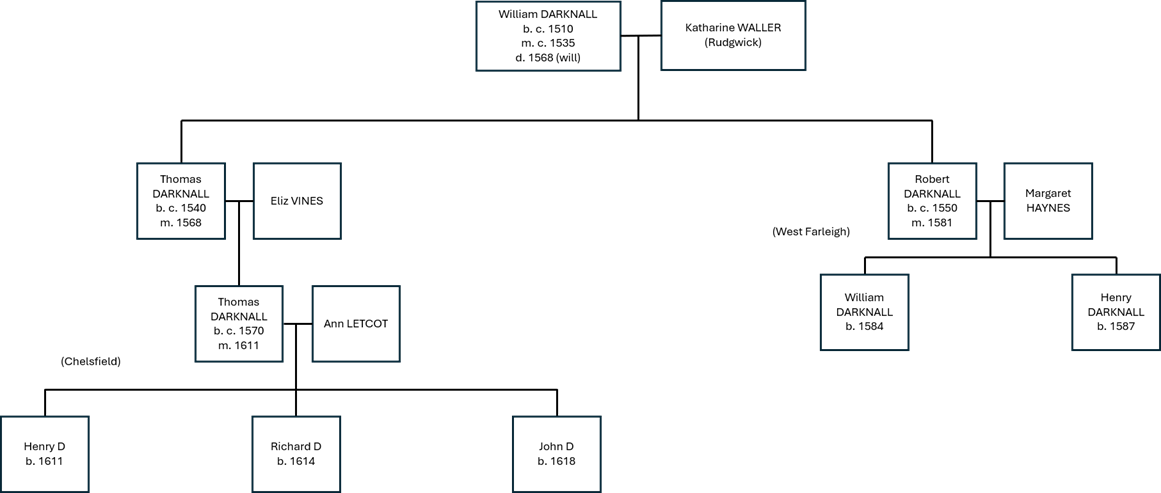
His will tells us a lot. His wife
was named Katherine and he had two sons Thomas and Robert; he had two daughters
Joan and Marie. He lived in Rudgwick. He left to all his children various sums
of money but to his sons,
(a) Thomas, he
leaves HATHERIDGES in Chiddingstone
(b) Robert, he
leaves PILBEAMS in Chiddingstone
The rest of his estate he leaves
to Katherine.
The overseers of the will are very
interesting. They are Edward Darknall of Slinfold, “the elder” and John Waller
of Ifield, “my brother-in-law”. This is most extraordinary; in the Slinfold
registers it is quite clear that John Waller of Ifield married Dorothy
Darknall, daughter of Edward Darknall of Slinfold in 1571, three years after
William had died. Further in 1568, John Waller could have been William’s
brother-in-law only if by that date he had married William’s sister or if
William’s wife Katherine was John Waller’s sister. We must assume, therefore,
that William had married Katherine Waller.
The fact that William had married into the
Waller family explains why he chose Edward Darknall of Slinfold as his
overseer; Edward was friendly with the later father-in-law to John Waller. This
choice was deliberate and passed by Edward Darknall of Parham who, it is
suggested, was William’s brother.
But it was most unfair to any genealogist.
Chapter IV
The Story of
Robert Darknall of Penshurst
The Darknalls’ connection with Sussex does
not stem only from William of Chafford. The position is complicated by the fact
that William’s half-brother Robert married Joan Fagger. The Fagger family owned
much land in Sussex and Herts., had interests in other counties and were very
influential. At this point it is necessary to study a brief Fagger pedigree.
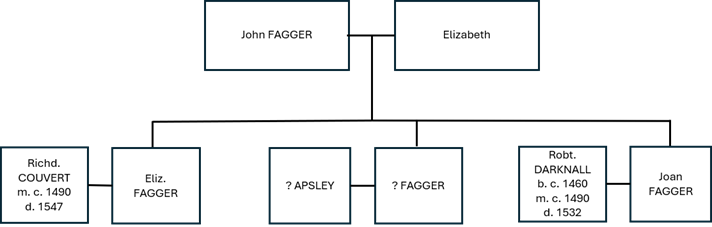
FAGGER is sometimes spelt VAGGER and the
alias is a well know name SILVERLOCK. I have a great many notes on the family, extracted
mostly from Sussex Records.
Robert’s full life is recorded in “DARKNALL
of Sevenoaks” and the following notes refer particularly to Sussex. He was born
it is suggested 1460-65 at Penshurst and lived all his life at Salmons. One
imagines that he had few difficulties to face and that his interests lay almost
entirely in the district where he was born and bred. He is concerned in may
land transactions from 1485 onwards but they are nearly all local affairs in
Kent. It was his mother, his wife and two of his sons who widened Robert’s
world and involved him in business in Sussex.
Robert was a wealthy man long before his
father died in 1507. In dealing with his wife’s Sussex property, Robert had to
travel and this was not an easy matter in the late 15th century, but
he had to attend Manor Courts. In this way, about 1488, he became acquainted
with the Couvert [Covert] family; they were rich Sussex folk, with a long
pedigree, who owned much of the county as well as property in Herts and
elsewhere.
John Couvert was born in 1472, married
Isabel, the only daughter of Sir John Pelham and died a young man in 1503, leaving
his estate to his cousin, Richard Couvert.
This Richard, before he died in 1547, married four times and two of his wives
are of interest to the Darknalls. He must have been about the same age as
Robert Darknall III and the two became friendly nearly twenty years before
Richard Couvert inherited his cousin’s estate.
In the early 1490s, Richard Couvert married
his first wife a young lady named Elizabeth Fagger. She had two sisters one of
whom, Joan, married Robert Darknall III about the same time. The third sister
appears to have married an Apsley. In marrying off his daughters, John Fagger
paid out a handsome dowry in each case but seems to have complicated matters by
giving them each a third of several properties. These included Oreham Manor,
tenements in Henfield, Abarton, Woodmancote and Warnham in Sussex. Also
included were the Manor of Mountham and tenements in Findon, Sullington,
Washington, Worthing, Chichester, Horsham and Steyning. In addition, there was
much land in the vicinity of Harpenden in Hertfordshire, the Manor of
Dacheworth.
We must now return to Richard Couvert. His
first wife, Elizabeth Fagger, was still alive in 1497 but after her death soon
afterwards Richard married Elizabeth, daughter of George Newle, Lord Burgenenne
[George Neville, Lord Burgavenny] and widow of Thomas Berkeley. She died soon
after and then Richard married Jane Ashburnham, daughter of William Ashburnham
and widow of William Apsley. Jane died in 1527 and Richard married his fourth
and last wife, Blanche, the daughter of John Vaughan.
Richard Couvert died in 1547 and his heir
was John Couvert who was born about 1475 and had married Elizabeth
_____________ by 1497. This John must have been the son of Richard Couvert and
Elizabeth Fagger since it is he who appears in the documents connected with
Dacheworth up to 1533. The reason for supposing that John Apsley married the
third daughter of John Fagger is that he appears with Richard Couvert and
Robert Darknall in the early Dacheworth transactions and thirty years later
John Apsley’s son John, and Robert Darknall’s sons Edward and Robert likewise
appear. A further point is worth recording. Richard Couvert, when he died in
1547, was High Sheriff of Surrey and Sussex and also Commissioner for Sewers. This
implies that he took a deep interest in sea walls on the coast of Sussex.
We must now return briefly to Penshurst, where
we meet two of Robert Darknall’s close friends, Robert and Henry Goseborn. All
three were about the same age and they grew up together in that delightful
village. The Goseborns, in years to come, were responsible for so many of the
actions of members of the Darknall family; they were responsible for the sale
of Salmons; they brought great influence to bear on the family in Sussex. But
[as] their activities largely concern Kent, we shall refer to them when we
consider Robert’s son, Robert of Canterbury.
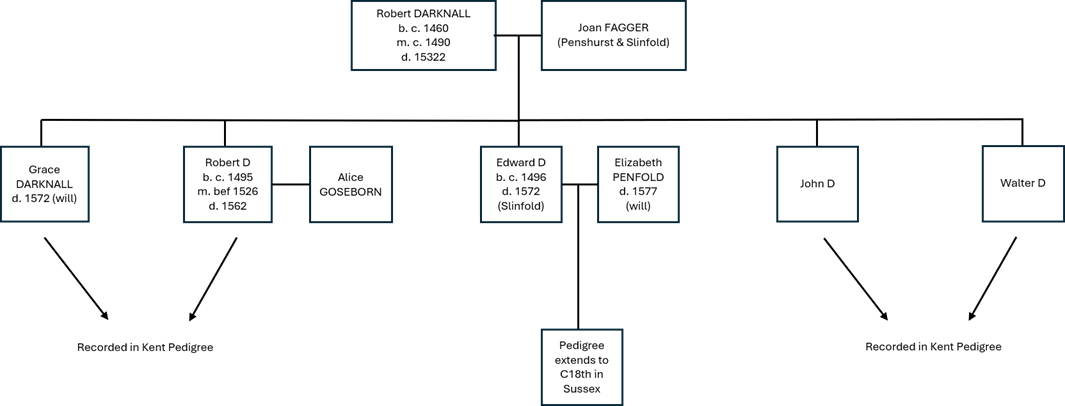
At this point we must examine Robert
Darknall’s own family.
(a) His eldest son,
as we shall see, married Alice Goseborn. As Robert IV he has his own adventures
recorded.
(b) The
second son, Edward, married Elizabeth Penfold, a member of another old Sussex
family, inherited some of the Fagger property, moved to Sussex and died there
in 1572.
(c) Daughter
Grace married William Cressey and is buried in the church at Harpenden where
she is commemorated by a fine brass.
(d) The
third son was John, the father of William Darknall who became rector of
Penshurst.
(e) The fourth and
youngest son was Walter who became Vicar of Sevenoaks.
Robert Darknall’s arms, impaled
with Fagger, may be seen in Penshurst Church. The date of his death is fixed by
the Manor Court Rolls. The Rolls also indicate the division of Robert III’s estate
as follows:
(a) To Robert IV
Salmons
Fagger land in
Hertfordshire
Interests in
Sussex
(b) To
Edward
Fagger land in
Sussex
(c) To
Grace
Fagger land in
Hertfordshire
(d) To
John
Property in
Westerham, Penshurst, Leigh and Edenbridge
(e) To
Walter
A cash settlement
References to Robert Darknall III will be
found many times in the Letters and Papers of Henry VIII and in hundreds of
deeds and other documents in the Public Record Office. These are recorded in
the Sevenoaks history; few of them concern the county of Sussex. When he died
in 1532, his neighbours must have remarked on the difference between the Robert
who had just passed on and the Robert who remained. Robert III of Salmons was a
proud and probably a good man; his heart lay in Penshurst; he was a countryman.
His son Robert IV of Canterbury as we shall see was an unscrupulous, ambitious and
selfish individual with a mind that turned to politics and intrigue. He cared
nothing for Salmons; he appears to have cared little for his family; he cared
only for himself and his advancement.
Chapter V
The Story of
Robert Darknall of Canterbury
This concerns Robert IV who was born at
Penshurst some years before 1504, his younger brother being born in 1497. He
was the eldest son of Robert III and lived partly at Salmons and, probably, partly
at Pilbeams. In the early sixteenth century it was not uncommon for three
generations to live in one big house at the same time. He was a boy of about
eleven or twelve when his grandfather Walter Darknall II, died in 1507. We know
how he grew up and married Alice Goseborn, daughter of the local Rector. This
must have been 1515 – 1520. At the time, his good father-in-law, who was
probably better at business than he was at religion, was well established in
Canterbury and was making money fast. Robert IV left Penshurst and settled down
with or near the Goseborns. Assisted and encouraged by his father-in-law,
Robert started buying and selling Church property in East Kent and in London.
No doubt he made a handsome profit from it. We will now leave Robert at his
home in Canterbury and study a little English history.
King Henry VIII, it is well known, suppressed
the Monasteries between 1536-1539 and confiscated all the rich lands and
houses, many of which he sold to his friends. One of the chief instruments in
this act of vandalism was Sir Richard Rich, the Chancellor of the Court of
Augmentations; this office was created to divert to the crown all the lands and
movables of the unfortunate monasteries. Another was Sir Thomas Willoughby,
Chief Justice of Common Pleas.
From the time he moved to Canterbury, Robert
never looked back. He successfully hood-winked three sovereigns; the first was
Henry VIII; then Edward VI; then Mary I. It is quite clear that had Robert
lived in 1965 he would have been put in prison; he was far from being honest. A
fourth sovereign discovered this only after Robert was dead.
Robert’s adventures are recorded in Kent and
the following brief summary may suffice for Sussex.
(a) 1522. Robert
became a Freeman of Canterbury.
(b) 1532. He
sold Salmons to Sir Thomas Willoughby.
(c) 1532. He
became associated with Willoughby who was
planning the Disolution.
(d) 1536. He
was elected one of the two MPs for Canterbury under the most disgraceful and
dishonest circumstances.
(e) 1537-1545. Robert
became the receiver of stolen property all over the Country, including Sussex.
There are over 60 deeds in the Public Record Office to prove this.
(f)
1537. He became a Gentleman of the King’s Household and a
favourite of Henry VIII.
(g) 1545. About
this time, his son, Robert Darknall V, entered the household of Richard Lord
Rich. (Robert V has an interesting and surprising career)
(h) 1553. He
became a Teller of the Treasury.
(i)
1553. Robert was involved in the Wyatt Rebellion and was pardoned.
(j) 1562. He
died.
Robert’s personal interests in
Sussex are shown in Sussex Records.
He appears, however, to have been
concerned indirectly in the martyrdom of Alexander Hosmer and Ann Ashdown in
1557, a most unpleasant business.
But, as the Kent history shows, Robert
as eldest son exerted considerable influence over his younger brother Edward, and
probably over his cousins, all of whom lived in Sussex.
At this point, we must consider
his pedigree.
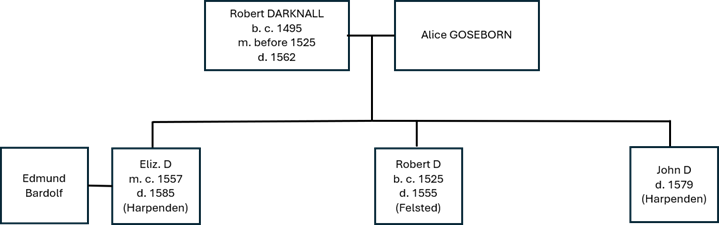
We know from the Salmons deeds that Robert
IV inherited much of the Sleighter and Fagger property. One point is very
important. There is a link between the FAGGER and the BAYLEY sides of the
family as late as 1572. Grace Darknall was sister to Robert of Canterbury. She
married William Cressey who died in 1559. Then she married Thomas Johnson. When
she died in 1572 she left £10 to her “nephew” Robert Darknall. This Robert could
not have been her brother Robert’s son because he died in 1555. The only Robert
Darknall alive in 1572, as far as we know, was Robert, the son of William
Darknall of Rudgwick who was Grace’s cousin. His adventures are recorded in
Chapter VI.
With a view, possibly, to making research
interesting for a member of the family to be born three hundred years later,
Grace Darknall’s (Cressey, Johnson) great nephew Edmund Bardolf married
Elizabeth Darknall, daughter of Grace’s brother Robert and her own niece. It is
not unlikely that Grace and her brother Robert were friendly with their cousins
of Rudgwick. All were married to wealthy families.
Chapter VI
The Story of
William Darknall of Rudgwick
William is of interest in that he was the
first one of the family to be born in Sussex, c. 1510. As suggested in the
draft pedigree, he was the elder son of William Darknall of Chafford. His story
begins where that of his father leaves off and in the past there has been
considerable confusion as the result. It seems likely that, before or after his
father’s death, the family moved from Chafford to Rudgwick. Here they lived for
many years; his widowed mother, Joan Darknall, died there in 1564. Four years
later, William himself died there in 1568.
His will (fn10), to which we have already
referred, tells us the following:
(a) His will was
made in August 1568, three months before he died.
(b) He
left 4d. each to his godchildren and to the mother church of Chichester.
(c) He
is described as “of Rudgwick” and “gent”.
(d) He
left to “Thomas my son” over £16 and effects.
(e) To
“Robert my son” he left £10 and effects.
(f)
“Joan my daughter” received £13 at the age of 21 or marriage; hence Joan
was born after 1547.
(g) “Marie
my daughter” received £6 under the same conditions.
(h) With
the exception of two pieces of land in Kent, his widow Katherine received the
rest of the estate; it should be noted that William had interests in Dorset.
(i)
Thomas received Hatheridges in Ciddingstone.
(j)
Robert received Pilbeams in Chiddinstone.
(k) Thee
overseers were Edward DARKNALL the elder of SLINFOLD and John Waller of Ifield
my brother-in-law.
(l) Probate
was given 6 Nov. 1568.
The reason why William chose
Edward Darknall of Slinfold who was his cousin for the duty of overseer,
instead of Edward Darknall of Parham who was his brother, is explained
elsewhere.
The wording of the will shows
that William’s children were all young at the time he mad his will; his widow
is made the sole executrix.
It is this William who is
mentioned in the Salmons Indenture of 1567
and the reference is important because it provides additional proof that he was
a direct descendant of Walter Darknall who died in 1507.
William’s line continued. His
descendants returned to Kent and his great-great grandchildren lived near
Chiddingstone.
Chapter
VII
The
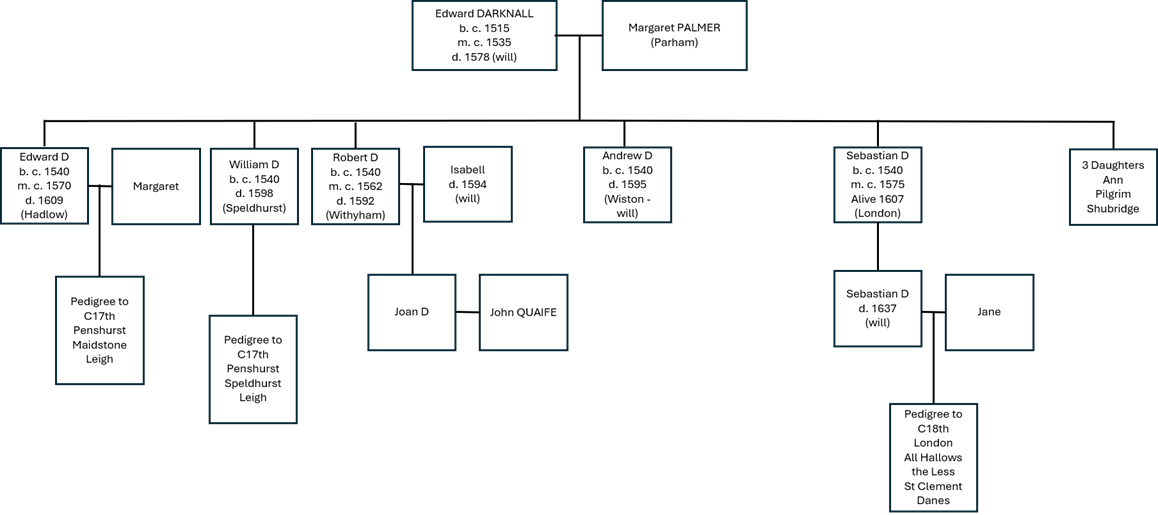
Story of Edward Darknall of Parham
It is suggested that [he] was the younger
son of William of Chafford, that he was born c. 1510, married c. 1530 to a
local lady, Margaret Palmer and lived all his life in the small village of
Parham. We know that he died in 1578 because he left a will.
Unfortunately, his will tells us very
little. He was “of Parham” and a “gentleman”. He left half his possessions to
his widow Margaret and half to his children. But only one child, his son
Sebastian, is named. The widow lived until 1607 when she must have been nearly
ninety.
There are two very important witnesses to
the will, Thomas Palmer and William Palmer. And both lived in Parham. At this
point it is necessary to study the village. The history of Parham Park was
published in Country Life and a few notes have been extracted therefrom. The
Palmers were connected with Parham only from 1540 until 1577; their pedigree at
this time was as follows:
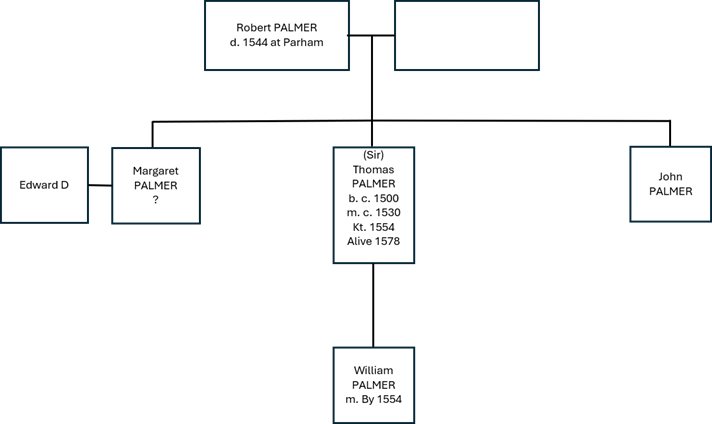
The brief association between the Darknalls
and the Palmers must have been on these lines. The hamlet of Parham had less
than 100 people living in it in 1086; there are about 90 living there in 1965.
It appears likely, therefore, that about the same number lived there in 1540.
Reverting for a moment to William of
Chafford (who is suggested as Edward’s father) he left his Kentish property to
his elder son, William of Rudgwick. He no doubt left his property near Chafford
– Withyham – Rotherfield to his younger son Edward.
In 1533 and following years, John Palmer had
much business with Robert Darknall of Canterbury, John Apsley and John Covert
in Sussex. This John Palmer may have been a close relative, possibly son, of
Robert Palmer. Whether this is so or not, the fact remains that Edward Darknall
about this date settled down at Parham and became friendly with the Palmer
family who were also newcomers to this small village and who had bought the
Manor of Parham about 1540. Edward must have become very friendly with them. He
lived near or with them for some forty years. When he made his will in 1578, he
asked Sir Thomas Palmer and William Palmer to be witnesses. There must have
been some reason for this; it is suggested that the reason was Margaret Palmer,
who became Edward’s wife.
And what of Edward’s son Sebastian? For many
years, all that we knew was that he was living in London in 1607 but there
was no trace of his brothers and sisters. His son, also named Sebastian,
died in London in 1637
and the pedigree continues well into the eighteenth century, largely in London
and Kent.
Then, quite recently, a will turned up in
Sussex of Robert Darknall of Withyham who died there in 1592. This altered the
picture completely. The will is a long one and mentions many of Robert’s
relations (but not Sebastian); the clues given link up with Penshurst,
Speldhurst, Leigh and Hadlow in Kent.
This Robert was a well-to-do yeoman who
lived at a house named Buckhornes in Withyham, owning considerable property in
the district. The will undoubtedly discloses the “children” of Edward Darknall
of Parham and the descendants, for all I know, may be living at the present
day.
One final note. Edward died in 1578. Parham
House was built in 1577. It is possible, even probable, that Edward, who was so
closely associated with the Palmers in a minute and rather inaccessible
village, was in some way involved in the planning of it.
Chapter VIII
The Story of
Edward Darknall of Slinfold
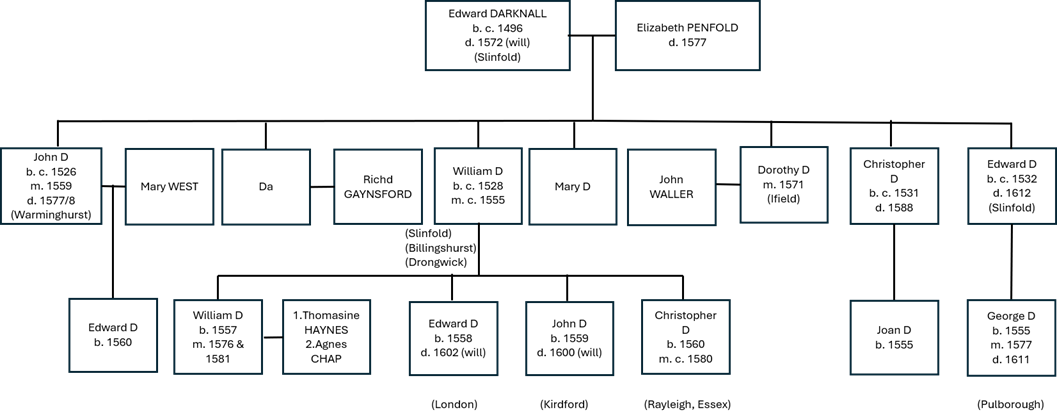
Edward was born at Penshurst c. 1496, the
second of four sons of Robert Darknall III and is wife Joan (Fagger). His
mother died long before 1532 and having inherited some Fagger land in Sussex,
Edward moved to Slinfold where he was to spend the rest of his days. Soon
afterwards, he married Elizabeth Penfold, a member of an old and wealthy Sussex
family. If one may judge from her will,
and the way in which she managed her near relations, Eizabeth was a very strong
character.
Edward and Elizabeth had at least seven
children, all of whom were born at or near Slinfold. His business interests in
land extended into Kent, Surrey, Essex, Hertfordshire and elsewhere. He was
described as “gentleman” and was regarded as someone of importance in the
county.
My only complaint is that Edward made things
difficult both for me and for the late Mr Challen (a learned Sussex and London
genealogist) by tying the Darknall family up in knots. This he did by being
friendly with “cousin” Edward Darknall of Parham. Both Edwards were roughly the
same age, they lived near one another, they had interests in the same property,
they had, naturally, relations in common to both of them and, between them made
it almost impossible for me to tell which Edward was which. Eventually, I was
able to sort them out. But Edward of Slinfold had the last word; he confused
the laws of inheritance.
When he died in 1572, Edward left no will
but a lot of property; this was administered successfully by his widow until
her death in 1577. Elizabeth, on the other hand, left a long and clear will;
in this she enumerates her family and the record fits in well with the entries
in Slinfold Parish Registers. This proved very helpful to me. It should be
noted that in 1577, her son John is alive.
Next year, in 1578, there was a family
squabble about who owned wat; all concerned had to return to John Fagger who
had died peacefully 100 years previously. An IPM was called for and John Apsley
was a member of it.
The verdict of the Inquest was as follows:
(a) Edward Darknall
died 22 March, 1572.
(b) His heir at the
time of Edward’s death was his son John. (No Gavelkind operated in this part of
Sussex and, according to the Inquest, the eldest son inherited all). But, in
1578, John was dead. Hence, if he was alive in 1577 and dead in 1578, he must
have died 1577/8. According to the jury, John’s son Edward inherited. Edward,
it was shown, was born in 1560.
In her will, Elizabeth Darknall
disposed of her own and Penfold property. It is of interest to note, however,
that the overseers to the will were Thomas Michell of Rudgwick, (who is
recorded in so many Darknall wills) and her husband’s cousin, Edward Darknall
of Parham!
Edward’s
descendants flourished all over Sussex; no doubt some are alive today.
Chapter
IX
Conclusion
Even if it were considered necessary, it
would be too costly to publish the History of the Sussex Darknalls. These brief
notes, therefore, are extracted from a much larger work and there are five
copies only. One is in the Library of Congress, Washington. This is because
there are some 5000 members of the DARKNALL, DARTNALL, DARNALL families
registered in the USA.
In due course, all my notebooks on Sussex
will be sent to the Sussex Archaeological Society.
These notes, brief as they may be, have
taken me many years to write and I owe a debt to the late Mr Challen whose
advice and assistance sustained me when I felt I was completely frustrated. In
order to obtain the necessary evidence, it became necessary to study the
following:
(a) Other
Families
These families,
most of whom are definitely Sussex in origin, have connections with DARKNALL
either by marriage, inheritance or business.
|
RICH
|
ALPHEY
|
READE
|
CARRYLL
|
|
WILLOUGHBY
|
PALMER
|
GORING
|
WEST
|
|
GATWICK
[GRATWICK]
|
NYE
|
JAMES
|
BORE
|
|
IVERY
|
JORDAN
|
APSLEY
|
SHELLEY
|
|
WALLER
|
FAGGER
|
BAILEY
|
FULLER
|
|
KNIGHT
|
COVERT
|
PENFOLD
|
WALEYS
|
|
CLITON
|
SLEIGHTER
|
TREELE
|
GOSEBORN
|
|
TICHBORN
|
|
|
|
(b) Properties
They are too
numerous to record in these notes but, briefly, are as follows:
BAILEY
8
FAGGER 26
PENFOLD
4
Misc
4
(c) Parish
Registers
I have extracts
from 12 Parish Registers in Sussex; I have examined over 30 others in vain;
many more remain to be searched.
(d) Sussex
Wills
These
references are taken from an Index of some 200 Darknall wills.
1504 Walter
Darknall Penshurst PCC, ADEANE, 36
1568 William
Darknall Rudgwick Chic. Vol. 11
1577 Elizabeth
Darknall Slinfold PCC, LANGLEY, 4
1578 Edward
Darknall Parham PCC, LANGLEY, 21
1592 Robert
Dakenol Withyham Arch. Lewes, A9, 94-119
1594 Isabel
Durtnall Withyham COBHAM, 33
1600 John
Darknall Kirdford PCC, WALLOP, 57
1602 Edward
Derknall Wadhurst PCC, MONTAGUE, 79
1611 George
Darknall Pulborough Chic. S. Dean 21
1613 George
Darknall Aslington Chic. S. Dean 9
1682 John
Darknall Nuthurst Chic. 27, 358
1636 Edward
Dartnall Billinghurst Chic. 19, 25(b)
1721 William
Dartnall Warnham Chic. 33, 76
1610 Michael
Darcknoll Withyham Arch. Lewes, 3, 16, 319
(e) Sussex
Administrations
1612 Edward
Darknall Slinfold Chic. 11, E 238
1610//1 Michael
Darknall Withyham Lewis wills
1611 William
Darknall North Stoke Chic. 11, E 218
1563 John
Darknall Warminghurst Chic. 11, A 48
1658 William
Darknall Slinfold PCC 1655-60, 3
(f)
Sussex IPM
1572 Edward
Darknall Slinfold C 142/187/91
1564 William
Darknall Slinfold Sussex Rec. 111, 25
(g) References
[Included as
footnotes]
If, before I hand over my notes to the
Sussex Archaeological Society, anyone is interested and wishes to obtain
further information, I may be contacted by writing to
Lieut-Col C.S. Durtnell,
c/o
The Manager,
Westminster
Bank Ltd.,
SEVENOAKS,
Kent.